Lot #16 - Boris SMERTINE, 1947-1993 (Russia)
Boris SMERTINE, 1947-1993 (Russia)
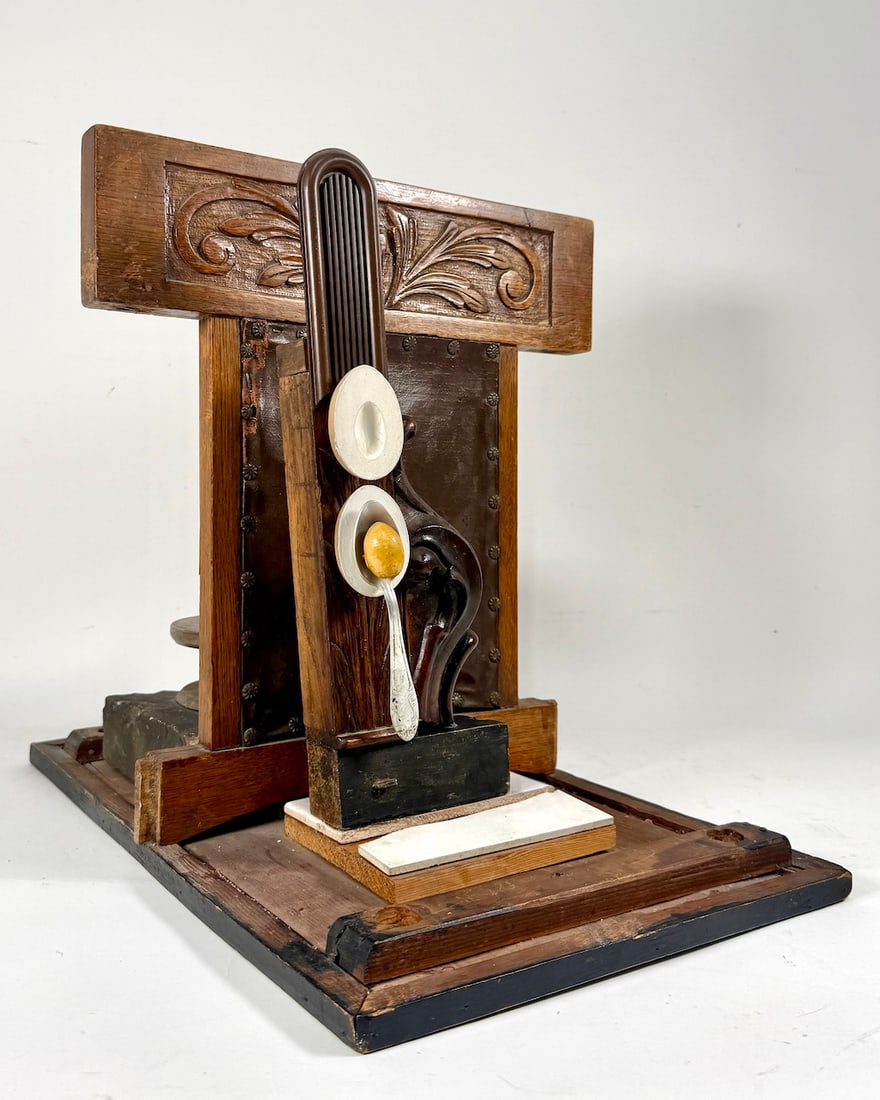


Estimate: 2 000 - 4 000 £
Auction ended
Lot Description
Boris SMERTINE (1947-1993)
From the series «The artist’s table», 1987-1992
Sculpture-volume (wood, leather, stone, ceramic, metal)
Height 42 cm (16 1/2 inches)
Base dimensions 50 x 31 cm (19 2/3 x 12 1/4 inches)
Published in catalogue of Boris Smertin art (printed catalogue included to the lot)
Boris Leonidovich Smertin (March 11, 1947, Rostov-on-Don – March 7, 1993, Moscow) was a Russian artist, sculptor, and master of assemblage. In 1973, he graduated from the Moscow State Academic Art Institute named after V. I. Surikov. From 1967 onward, he lived and worked in Moscow.
Until 1988, Smertin primarily exhibited graphic works. Beginning in 1988, he presented assemblages, sculptural objects, paintings, and graphics at various exhibitions. From 1987 to 1992, he was a member of the Bez Chetvyortogo (“Without the Fourth”) group, together with Vladimir Kuzmin and Boris Mikhailov. From 1989 to 1993, he worked in his own studio in Hamburg. He died in Moscow in 1993.
In 2005, Smertin’s works were included in the long-term exhibition “Revision of Material” at the Central House of Artists in Moscow, organized by the State Tretyakov Gallery. It was only after this exhibition that the artist began to attract more sustained attention from Russian and international critics, and the prices of his works at international auctions increased significantly. “For me, the form of art now loosely referred to as assemblage art is the field of creative work in which I find my existence most natural and organic, where I can fully express myself and realize my abilities.
I can almost physically sense the relief-like metaphorical qualities and the specific character of the material from which the intended work is created. All of this allows me, when necessary, to freely and organically incorporate into the process of creating a work any objects or material structures from everyday life that serve the artistic concept. Once the right solution is found, their inevitable transformation gives rise to a whole fireworks display of associations—some connected directly with real life, others with the strange and fantastical worlds that grow out of it.
Within these combinations, and interacting when necessary with pictorial or other structures, the objects acquire qualities similar to those structures. They help create a visual space of equal emotional intensity, in which any superficial ‘games’ with texture are completely excluded. I seem to belong to those artists for whom conventional criteria of authorship do not always work. Authorship is determined not so much by a scale of external visual characteristics as by a certain charge of artistic energy operating at the subconscious level. It is through the impulses of this energy that the distinctive character of the artist’s work emerges. The appearance of a work is, in essence, the very substance of the creative process. I work with a wide variety of subjects. There are no subjects or themes that cannot be represented. Life itself offers us countless possibilities.” Boris Smertin occupies a special place in this exhibition because of the way he approaches the idea of the magical through objects and things.
Stylistically, his work can easily be associated with the art of assemblage and with the traditional practice of working with found objects. There are also clear connections to Pop Art and to the irrational, illogical character of Dada. Yet in reality, Smertin’s subject goes beyond the avant-garde’s traditional approach to the object that developed throughout the twentieth century. In his personal artistic practice, he seeks to reconstruct the entire life story of an object: to recall its past as something displayed and admired, its present state, and the unnecessary or forgotten existence that awaits it in the future. The artist examines the whole of human life through things.
Every object in Boris Smertin’s assemblages becomes part of a larger field of human existence. The very ordinariness of these objects reveals their ability to merge with human qualities, to become a form of human existence, and to function almost as an extension of the human body.
For Boris Smertin, the world speaks through things and objects. It reveals itself as a kind of magical theatre in which objects, rather than people, perform the roles. The artist continually asks himself whether the world can remain intact if even a single speck of dust falls out of its place—if something becomes unnecessary, superfluous, or forgotten. Smertin’s compositions acquire an additional meaning by bringing objects back from oblivion and saving them from disappearance. That meaning, in turn, returns to the human being with gratitude, affirming that human existence is not accidental and that each person has a unique and meaningful place in the world.
30% up to £100,000.00
28% up to £200,000.00
25% above £200,000.00
From the series «The artist’s table», 1987-1992
Sculpture-volume (wood, leather, stone, ceramic, metal)
Height 42 cm (16 1/2 inches)
Base dimensions 50 x 31 cm (19 2/3 x 12 1/4 inches)
Published in catalogue of Boris Smertin art (printed catalogue included to the lot)
Boris Leonidovich Smertin (March 11, 1947, Rostov-on-Don – March 7, 1993, Moscow) was a Russian artist, sculptor, and master of assemblage. In 1973, he graduated from the Moscow State Academic Art Institute named after V. I. Surikov. From 1967 onward, he lived and worked in Moscow.
Until 1988, Smertin primarily exhibited graphic works. Beginning in 1988, he presented assemblages, sculptural objects, paintings, and graphics at various exhibitions. From 1987 to 1992, he was a member of the Bez Chetvyortogo (“Without the Fourth”) group, together with Vladimir Kuzmin and Boris Mikhailov. From 1989 to 1993, he worked in his own studio in Hamburg. He died in Moscow in 1993.
In 2005, Smertin’s works were included in the long-term exhibition “Revision of Material” at the Central House of Artists in Moscow, organized by the State Tretyakov Gallery. It was only after this exhibition that the artist began to attract more sustained attention from Russian and international critics, and the prices of his works at international auctions increased significantly. “For me, the form of art now loosely referred to as assemblage art is the field of creative work in which I find my existence most natural and organic, where I can fully express myself and realize my abilities.
I can almost physically sense the relief-like metaphorical qualities and the specific character of the material from which the intended work is created. All of this allows me, when necessary, to freely and organically incorporate into the process of creating a work any objects or material structures from everyday life that serve the artistic concept. Once the right solution is found, their inevitable transformation gives rise to a whole fireworks display of associations—some connected directly with real life, others with the strange and fantastical worlds that grow out of it.
Within these combinations, and interacting when necessary with pictorial or other structures, the objects acquire qualities similar to those structures. They help create a visual space of equal emotional intensity, in which any superficial ‘games’ with texture are completely excluded. I seem to belong to those artists for whom conventional criteria of authorship do not always work. Authorship is determined not so much by a scale of external visual characteristics as by a certain charge of artistic energy operating at the subconscious level. It is through the impulses of this energy that the distinctive character of the artist’s work emerges. The appearance of a work is, in essence, the very substance of the creative process. I work with a wide variety of subjects. There are no subjects or themes that cannot be represented. Life itself offers us countless possibilities.” Boris Smertin occupies a special place in this exhibition because of the way he approaches the idea of the magical through objects and things.
Stylistically, his work can easily be associated with the art of assemblage and with the traditional practice of working with found objects. There are also clear connections to Pop Art and to the irrational, illogical character of Dada. Yet in reality, Smertin’s subject goes beyond the avant-garde’s traditional approach to the object that developed throughout the twentieth century. In his personal artistic practice, he seeks to reconstruct the entire life story of an object: to recall its past as something displayed and admired, its present state, and the unnecessary or forgotten existence that awaits it in the future. The artist examines the whole of human life through things.
Every object in Boris Smertin’s assemblages becomes part of a larger field of human existence. The very ordinariness of these objects reveals their ability to merge with human qualities, to become a form of human existence, and to function almost as an extension of the human body.
For Boris Smertin, the world speaks through things and objects. It reveals itself as a kind of magical theatre in which objects, rather than people, perform the roles. The artist continually asks himself whether the world can remain intact if even a single speck of dust falls out of its place—if something becomes unnecessary, superfluous, or forgotten. Smertin’s compositions acquire an additional meaning by bringing objects back from oblivion and saving them from disappearance. That meaning, in turn, returns to the human being with gratitude, affirming that human existence is not accidental and that each person has a unique and meaningful place in the world.
Conditions
As is on pictures
30% up to £100,000.00
28% up to £200,000.00
25% above £200,000.00
Auction Description

You can also be interested in:














CONTACT US
Should you need any further information, please do not hesitate to contact us.